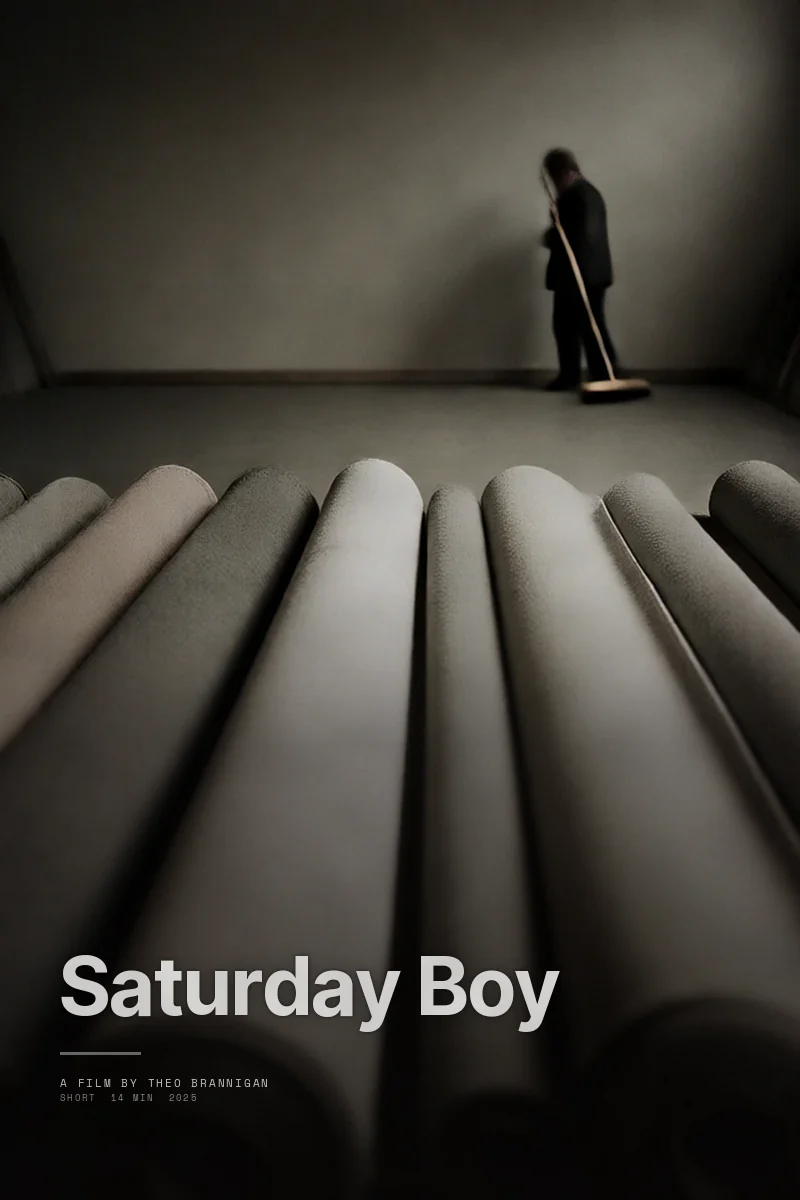
Comedy from the Naas Road, cast out of a Tuesday night drama group.
Director, Writer, Editor
Six episodes. The diocesan review runs the length of the season.
Two brothers, one van, and a job in Wexford that takes eleven hours.
Theo Brannigan worked six years as a runner and then an assistant editor at a post house on Camden Street, cutting corporate videos by day and his own shorts at night on machines he was technically allowed to use. He studied English, not film, and left a master's after one term. His shorts are all set within a mile of the Naas Road, where his family ran a floorcoverings shop until 2016, and most of them are cast out of a Tuesday night drama group in Inchicore that he still turns up to. He shoots on two lenses, works with the cinematographer Orla Devane and the editor Fintan Cusack on everything, and writes in a notes app on a phone with a cracked screen. He also cuts other people's films for a fee he describes as embarrassing, most recently Aurelie Mbeki's Calanques.
The people they keep working with.
Reviewed Temporada
The writing is sharp and the priest is a genuinely new character, a man who has stopped believing but has not stopped working, which is more interesting than doubt. What holds it back is that it looks like television from twelve years ago. Flat, front lit, safe. Brannigan has a voice. He needs a camera department that has one too.
A pilot has two jobs, introduce a world and make you need episode two, and this does both without a single scene of people explaining the world to each other. The funeral tea is a lesson in blocking. Nine speaking parts in one room and I could draw you the map of it afterwards. I want the rest of this.
I have been trying to write a fourteen minute comedy for two years now, and this is the one I keep going back to as proof that it can be done at all. The whole thing turns on a man not looking up from a clipboard. Six words of dialogue in the last minute and one of them is sorry. I would put it in front of anybody who still thinks short comedy has to be a sketch.
I put this on for a teenager who was waiting for his mother at the desk and he watched the whole thing standing up with his coat on. That is the review. It is very funny and it is kind to everybody in it, including the manager, which almost never happens in a film about a bad job.
Charming, well made, and about eleven percent slighter than it thinks it is. Brannigan writes dialogue that actors clearly love to say, and the boy is a real find. But the film reaches for a bigger ending than it has built room for. The shop closes, the mood turns, and I did not believe the turn. I laughed a great deal on the way there.
The joke I keep repeating to people is the one about the shoes, and I have ruined it every time, which is how you know it is built properly. Fourteen minutes, one Saturday, one boy who wants to be taken seriously by a man who cannot be bothered to take anything seriously. The last exchange lands so lightly you almost miss that it is the whole point of the film.
I saw a rough cut of this in Dublin last winter when Ines was still cutting and I was still pretending my own film was finished. It has got longer and quieter since, and it is better for both. The scene at the bus window is the sort of thin...